
I bought a house in Chesapeake twelve years ago with a perfectly ordinary gas range. I never questioned it. Then, during a kitchen renovation two years ago, my designer put a brochure on the table and said four words I didn’t understand: ‘invisible induction, hidden below.’
I spent three weeks researching it obsessively. Here is everything I wish someone had told me at the start — a complete invisible induction cooktop buying guide for American homeowners who are seriously considering this technology.
Invisible Induction Cooktop Buying Guide: What Is It and How Does It Work?
An invisible induction cooktop is an induction cooking module installed beneath your countertop surface, completely out of sight. There are no burners on top of your counter. There is no glass cooktop to clean. There is no visible appliance at all.
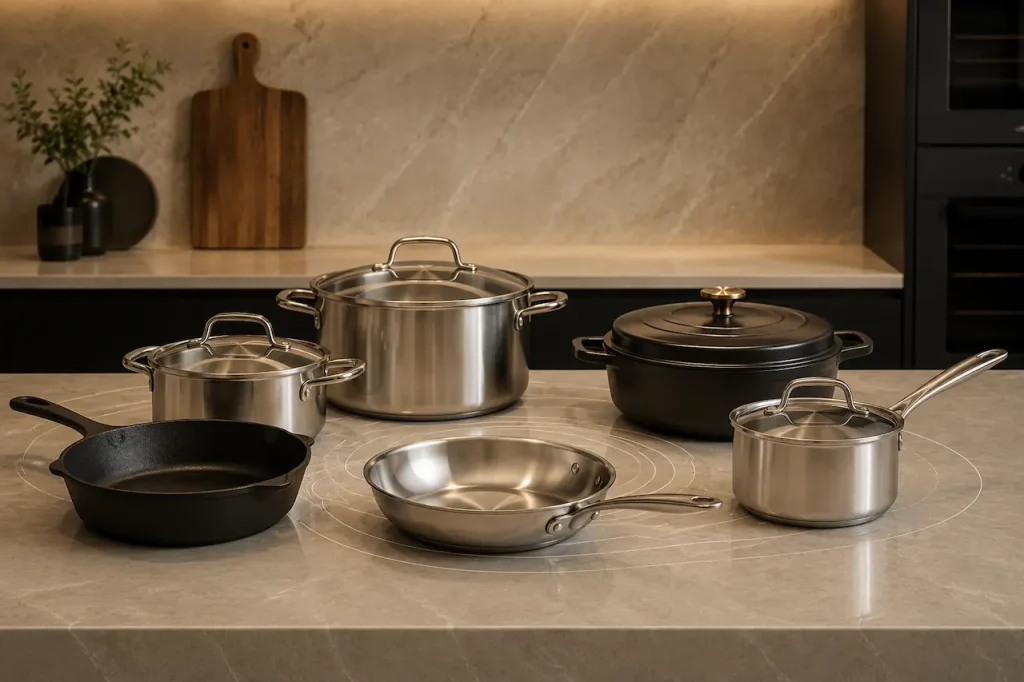
You cook directly on your countertop material — typically a high-density sintered stone like Dekton, Neolith, or Lapitec. The electromagnetic field passes through the stone and heats only the base of your ferromagnetic cookware. The surface itself remains cool.
The technology is the same electromagnetic induction that powers every standard induction cooktop on the market. The difference is purely architectural: the unit lives below, not on top.
5 Critical Invisible Induction Questions Answered
1. Is it safe?
This is always the first question. Yes — unambiguously. Induction cooking has no open flame and no glowing element. The cooking zone activates only when a compatible pan is detected, and shuts off automatically when you remove the pan. The surface temperature around your cookware remains low enough to touch safely.
For families with young children, this is one of the most compelling arguments for invisible induction: there is no exposed burner to reach, no hot glass surface to accidentally touch. The entire cooking interface has disappeared.
2. Will it work with my pans?
Any pan that works on a standard induction cooktop works on an invisible induction system. The quick test: hold a magnet to the base of your pan. If it sticks, the pan is induction-compatible.
Cast iron, carbon steel, enameled cast iron, and most stainless steel cookware all work. Aluminum, copper, and glass do not, unless they have an induction-compatible base layer. If you’re switching from gas, there’s a reasonable chance most of your cookware is already compatible — and the ones that aren’t are worth upgrading.
3. Can it damage my countertop?
Not when you use a compatible surface. The Invisible Induction Cooktop system is engineered specifically for surfaces like Dekton, Neolith, Lapitec, and select sintered stone and porcelain materials. These surfaces are thermally stable far beyond the temperatures any cooking scenario will produce.
What you cannot do is install this system under natural granite, marble, or standard quartz. Those materials are not thermally appropriate for direct-contact cooking. Your fabricator should be part of this decision from day one.
4. How powerful is it compared to gas?
More powerful, in most practical cooking scenarios. Electromagnetic induction converts roughly 90% of its energy directly to your cookware. Gas burners lose 60–70% to ambient heat. The result: an induction zone rated at 3.1 kW transfers more usable energy to your pan than a gas burner rated at 15,000 BTU.
Boiling a full pot of water, searing a steak at high heat, maintaining a low simmer for hours — every technique transfers without compromise. Professional kitchens have relied on induction for decades. The invisible format doesn’t change the cooking performance; it changes the visual footprint.
5. How much does it cost?
The Signature Invisible Cooktop starts at $3,400. The Hospitality Invisible Table — designed for dining surfaces — starts at $5,900. The Kitchen Island System, a full-island integration, is priced by custom quote depending on dimensions.
These figures do not include countertop fabrication, installation labor, or electrical work, which vary by region. A realistic all-in budget for a mid-range invisible induction kitchen renovation in the United States typically runs $8,000–$18,000 depending on kitchen size, countertop material, and contractor rates.
The Three Products in the Collection
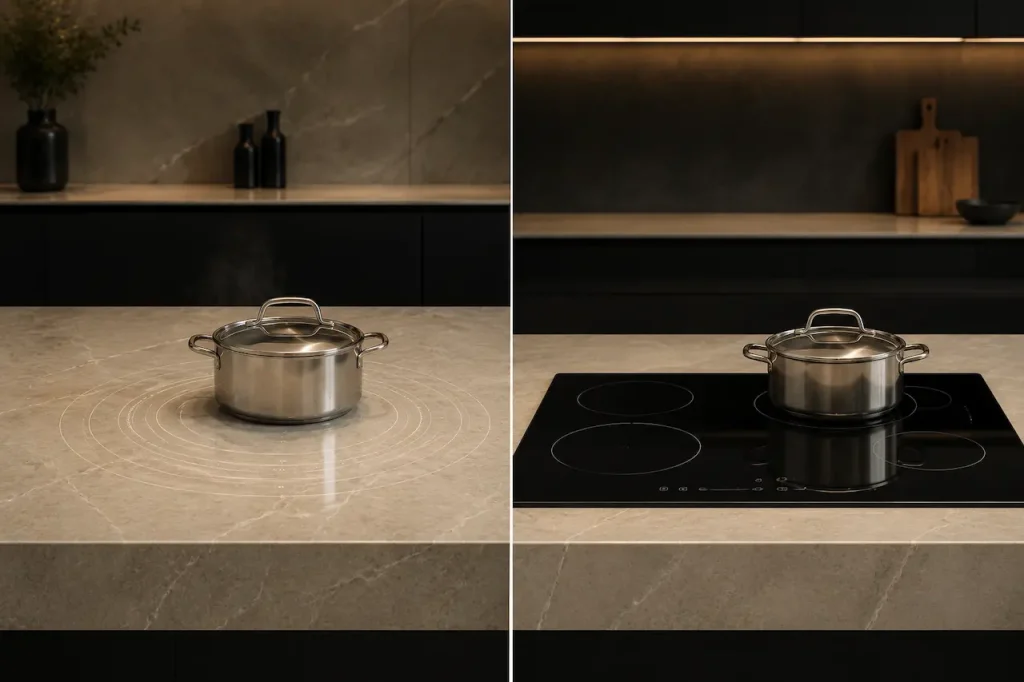
Signature Invisible Cooktop — from $3,400
The original 4-zone module. Designed for standard kitchen countertop installations where the homeowner wants to eliminate the visible cooktop without changing the overall kitchen layout. Three independently controlled zones — 1.8 kW, 2.4 kW, and 3.1 kW — cover every cooking scenario from delicate melting to high-heat searing.
This is the right product for most residential renovations.
Hospitality Invisible Table — from $5,900
A single seamless surface that functions as both cooking and dining space. Designed for open-plan living, where the distinction between kitchen and dining area is deliberately eliminated. The unit is engineered for full-table format stone, allowing you to serve hot dishes directly on the surface and cook at the table.
Increasingly popular in urban apartments, vacation properties, and high-end residential dining spaces.
Architectural Kitchen Island System — custom quote
Full-island integration designed in collaboration with your fabricator and kitchen designer. If you’re building or renovating a kitchen island and want cooking capability without any visible hardware, this is the specification. Pricing is project-specific; contact the trade team for a quote.
How to Install an Invisible Induction Cooktop
Understanding installation sequence is critical for buyers in the planning stage. Here’s the realistic timeline:
- Design phase: You select your countertop material (in consultation with your fabricator and the Invisible Induction Cooktop team) and specify placement of the cooking zones.
- Electrical preparation: The module requires a dedicated circuit. Your electrician handles this in rough-in phase, before countertops are installed.
- Module mounting: The unit is mounted from below the countertop substrate, typically by your kitchen fitter. This takes a few hours.
- Countertop templating: The fabricator templates the countertop knowing the module dimensions and placement.
- Final installation: Stone is installed over the module. No cutout in the surface. No visible hardware.
The key message for buyers: this is not a retrofit product for an existing kitchen. You plan for it from the beginning, or you don’t plan for it at all. If your countertops are already in, you’re looking at a full countertop replacement.
Who Is This Product For?
Based on what I’ve seen in the invisible induction community and my own research, the typical invisible induction buyer in 2026 looks like this:
- Homeowners undergoing a full kitchen renovation with design-forward priorities
- Architects and interior designers specifying for high-end residential or hospitality projects
- Homeowners switching from gas to all-electric cooking and wanting to take that transition to its logical visual conclusion
- Buyers of new construction who want the kitchen to reflect a modern aesthetic from day one
If you’re looking for a drop-in cooktop upgrade on a budget, this is not your product. If you’re investing in a kitchen that will still look architecturally relevant in 2036, this may be exactly what you’re looking for.
Where to Go From Here
The best next step is to use the product finder on the site to identify the right module for your kitchen dimensions and cooking style. From there, the Invisible Induction Cooktop trade team can connect you with an installation specialist in your area.
→ Explore the full collection at