
By Helen | Chesapeake, Virginia
The single question I get asked more than any other about premium appliances is what an invisible induction cooktop cost actually looks like when totaling up a real-world invoice’ Not the starting price on the product page — the real number. All of it. Including the countertop, the electrician, the fabricator, the whole project.
Here is the honest, complete answer. I’m going to walk through every cost component so you can build an accurate budget — no surprises.
The Starting Point: Invisible Induction Cooktop Cost Breakdown
There are three products in the Invisible Induction Cooktop collection:
- Signature Invisible Cooktop: from $3,400 — the standard 4-zone module for residential countertop installation
- Hospitality Invisible Table: from $5,900 — cook-and-dine format for island or table applications
- Architectural Kitchen Island System: custom quote — full-island integration at project-specific pricing
These are the module prices — the induction unit itself. They are not the all-in project cost. Everything below is additional.
The Other Cost Components (What Most Articles Don’t Tell You)
Countertop Material
This is typically the largest single additional cost for buyers switching to invisible induction. You cannot install this system under standard granite, marble, or quartz. You need a compatible sintered stone — Dekton, Neolith, or Lapitec being the primary options.
Sintered stone countertops cost more than standard granite or quartz. In the American market in 2026:
- Dekton or Neolith: $65–$120 per square foot installed (material plus fabrication plus installation labor), depending on slab size, edge profiles, and regional labor rates
- For a standard American kitchen with 50–80 sq ft of countertop: $3,250–$9,600 in countertop cost
- For a large island with 30–40 sq ft: add $1,950–$4,800
If you’re renovating your kitchen anyway and were planning to install high-end countertops, this cost is often already in your budget. If you’re switching from laminate or standard quartz specifically to accommodate invisible induction, it’s a significant line item.
Electrical Work
The module requires a dedicated 240V circuit. If your kitchen already has a 240V circuit for an electric range, the additional electrical work may be minimal — essentially reconnecting to the module.
If you’re converting from gas and need a new 240V circuit run from your electrical panel:
- Electrical panel upgrade (if needed): $1,500–$4,000
- New 240V circuit rough-in: $400–$900 depending on run length and local labor rates
- Permit and inspection: $100–$300 in most U.S. jurisdictions
Total electrical additional cost for gas-to-induction conversion: typically $500–$1,200 if the panel can support it, $2,000–$5,200 if a panel upgrade is required.
Installation Labor (Kitchen Fitter)
Module mounting by a qualified kitchen fitter takes a few hours. Labor rates vary significantly by U.S. market:
- Kitchen fitter labor for module installation: $150–$400 in most markets
- If part of a full kitchen renovation, this cost is often absorbed into the general contractor’s scope
Countertop Fabrication and Installation
This is included in the countertop material estimate above for most buyers, but worth calling out separately if you’re working with a designer who separates material and labor:
- Fabrication (cutting, edge profiling, finishing): $20–$40 per square foot
- Installation (setting, seaming, templating): $10–$25 per square foot
Ventilation
Many invisible induction island installations use downdraft ventilation systems, which are less expensive to install than overhead hoods. If you’re eliminating a gas range hood as part of this renovation, you may be removing a cost from your budget, not adding one.
- Downdraft ventilation system (supply only): $800–$2,500 depending on spec
- Installation: $400–$900
- If no ventilation change is needed: $0
Total Project Cost: Realistic Scenarios
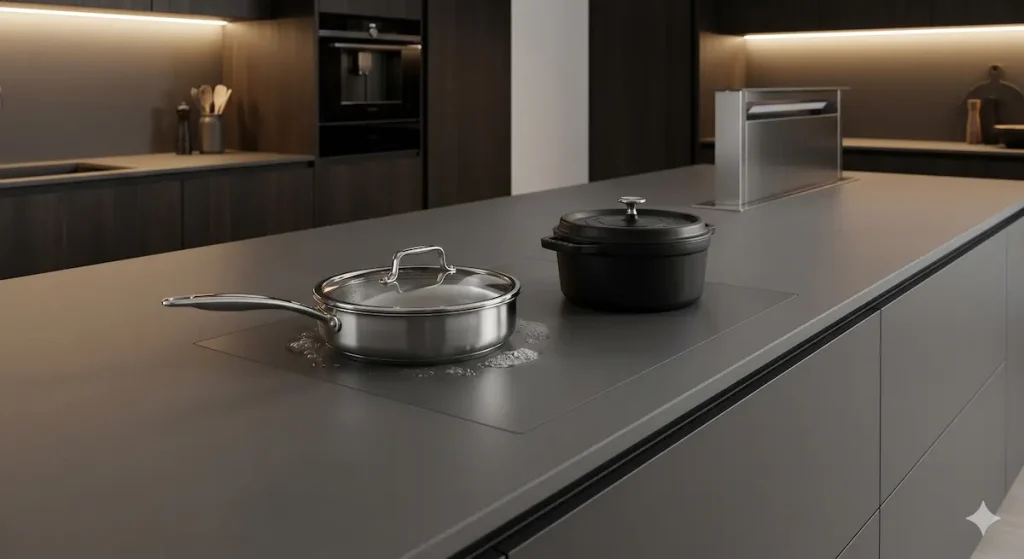
Here are three realistic all-in project budgets for invisible induction in the American market in 2026:
Scenario A: Part of a Full Kitchen Renovation
A homeowner renovating a 150 sq ft kitchen, specifying Dekton countertops throughout, switching from gas:
- Signature Invisible Cooktop module: $3,400
- Dekton countertops (150 sq ft at $90/sq ft installed): $13,500
- Electrical (new 240V circuit, panel adequate): $700
- Installation labor (absorbed into GC scope): $0 incremental
- Downdraft ventilation: $1,800 installed
Total: approximately $19,400 — with premium countertops throughout.
Scenario B: Island-Only Upgrade
A homeowner upgrading an existing island (replacing existing countertop with Neolith, adding invisible induction):
- Signature Invisible Cooktop module: $3,400
- Neolith island countertop (40 sq ft at $95/sq ft): $3,800
- Electrical (existing 240V circuit, minor modifications): $400
- Kitchen fitter labor: $300
Total: approximately $7,900 — a focused island upgrade.
Scenario C: Architectural Island System (New Construction)
An architect specifying a full island system for a custom home:
- Kitchen Island System (custom quote, estimated for large island): $8,000–$15,000
- Dekton full-island countertop (60 sq ft at $110/sq ft): $6,600
- Electrical (new construction, circuit already planned): $600
- Installation (absorbed into construction scope): $0 incremental
Total: approximately $15,200–$22,200 depending on island system specification.
What You’re Comparing Against
For context, here is what competing kitchen cooking solutions cost in the same American market:
- High-end gas range (Wolf, Thermador): $4,000–$12,000, plus range hood $1,500–$8,000, plus gas line work
- Standard built-in induction cooktop (Bosch, Miele): $900–$2,500, installed in a standard countertop cutout
- Full-surface induction cooktop (e.g., Bora): $3,000–$6,000 plus installation
Invisible induction is priced at the premium end of the kitchen appliance market — consistent with high-end range brands — and delivers a design outcome none of those alternatives can match.
The Long-Term Cost Picture
Operating costs favor induction significantly over gas. Induction converts roughly 90% of electrical energy to cooking heat; gas burners convert 32–40%. At average U.S. electricity and natural gas prices in 2026, most households save $150–$400 annually on cooking energy when switching from gas to induction — depending on cooking frequency and local utility rates.
Over a 10-year ownership horizon, those savings offset a meaningful portion of the installation premium.
Getting an Accurate Quote for Your Project
Every invisible induction project is slightly different in terms of kitchen dimensions, countertop material selection, electrical infrastructure, and contractor rates. The most accurate approach is to request a quote through the product page, then coordinate with your fabricator and electrician for countertop and electrical estimates specific to your home.